Saturday, October 17, 2015

EXHIBITION IN CARDIFF COMING UP

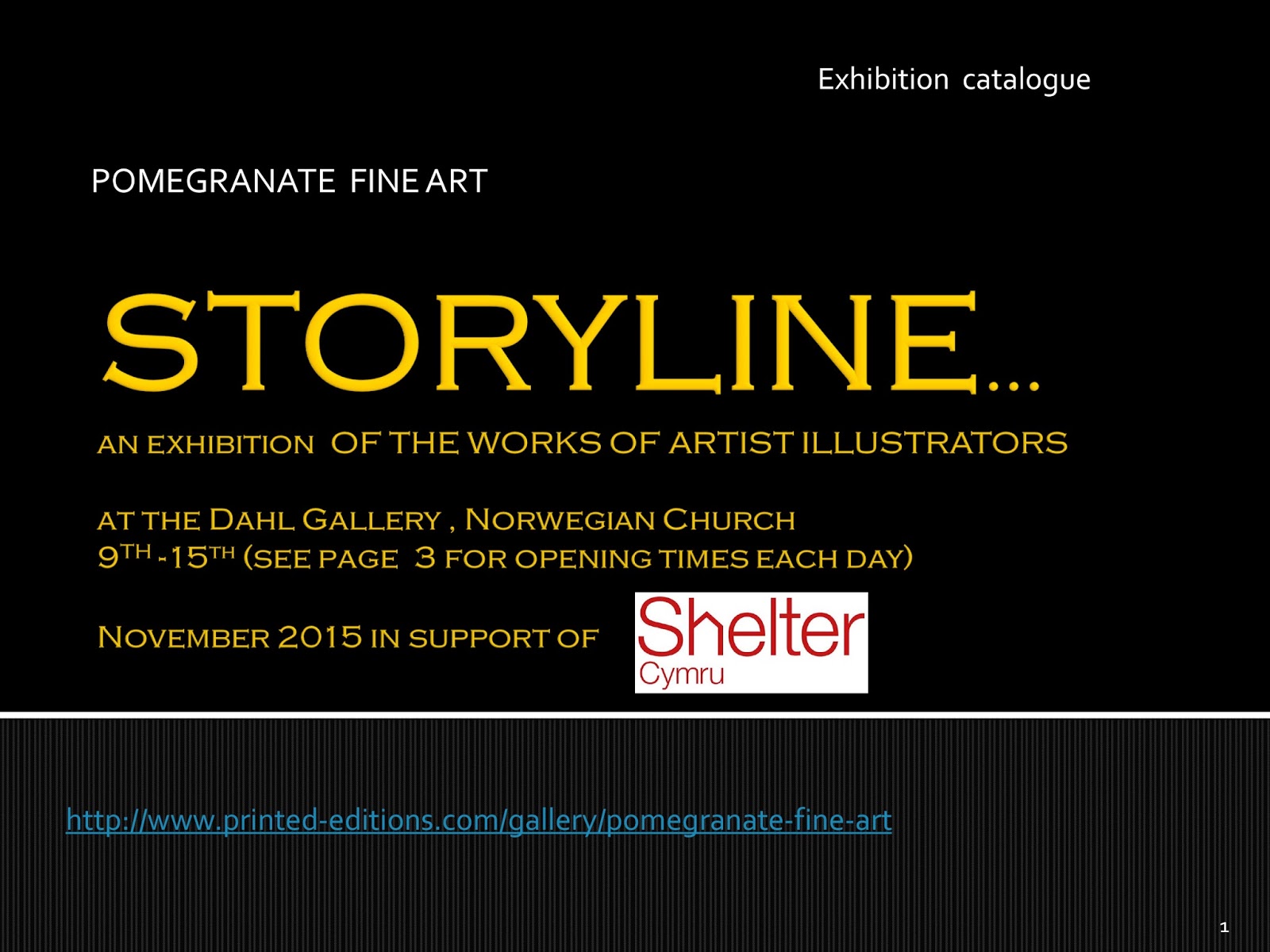
STORYLINE, an exhibition organised and curated by Bill Garnett (Pomegranate Fine Art) will be from 9th to 15th November at the Dahl Gallery, in the Norwegian church in Cardiff, in support of Shelter, Cymru.

About 20 prints and some artists' books of mine are included among the terrific artists participating. I'll be at the opening on 9th Nov. Come if you can but even if you can't, the work will be for sale on Pomegranate. BUY and support Shelter, as well as enhance your life with marvellous original artworks.


Looks like I can't upload the whole catalogue. Will ask Bill to re-format.

Thursday, October 15, 2015

MORE OLD SKETCHES

Reading Lucy and Tom's vivid and idiosyncratic impressions of their recent trip to the Netherlands I was motivated to look for some sketches I'd done during a trip to Amsterdam in the 1980s. In the same sketchbook there were also many quick drawings of poets, artists and other talking heads at various events I attended during those years.The ideal ambiance for sketching people is at a conference or concert where speakers/performers stay relatively still for long periods and you can be sitting quietly drawing, unobserved and undisturbed while still being part of the scene.

Amsterdam 1986: it was raining, the hotel was cheap and the mattress had lived, as they say.

Wet raincoat, Amsterdam hotel room.


Of course Van Gogh was on my mind. He shared my room and I angled the mirror so as to echo one of his subjects.


Dick Higgins was one of the speakers at a Bookworks conference I attended in Philadelphia in 1982.


Leon Cych and Peter Baines at the National Poetry Centre, London 1982. Peter Baines (AKA Street Talkin' Pete) was a friend and together with Marilyn, his wife at the time, we went on protest marches, including to the Greenham Common women's peace camp in 1983.
John Rety was a friend but there must be hundreds of people around the world who can claim that privilege, certainly many in my part of North London where he and his partner Susan Johns ran the Torriano Meeting House. Shortly before he died in 2010 I bumped into him (literally) in Camden Town and he said, let's do a comic strip, I'll provide the text, you draw the cartoons. He was like that, as if life was an ongoing conversation with time an irrelevant interruption. I said fine, let's do it. We were going to meet and work it out. Then he died. Everyone in the above sketches is dead, apart from me. And Leon Cych who I drew but never met (I've just Googled him and am glad to see he's alive and doing well).

John Rety and Gilbert Adair at a poetry event in London 1986.


Tuesday, October 13, 2015

NE ME QUITTE PAS


 I wonder if this song could ever be written, much less sung, at the present time?
The last few lines especially - would any self-respecting woman or man nowadays dare to say:
Let me become 
The shadow of your shadow
The shadow of your hand
The shadow of your dog

Nevertheless these are emotions which many people still feel, whether expressed or not. Nobody ever did it better than Jacques Brel in his terrific original, unpolished version - shared here from YouTube.

I've recorded myself intoning it just now, you can listen to it here .

My translation below is far from perfect but better than the awful ones I've seen via Google.

Ne Me Quitte Pas (Jacques Brel and Jacques Roman)

Don't leave me
Let's forget
Forget everything
That's already vanishing
Forget the time of misunderstanding
And the time wasted
Who knows how
Forget those hours
Which sometimes killed
With blows of why 
The heart of bliss.
Don't leave me (r)
I'll offer you
Pearls of rain
From countries where it never rains
I'll dig the earth
Even after my death
To clothe your body
With gold and light
I'll build a kingdom
Where love is king
Where love is law
Where you'll be queen.
Don't leave me (r)
I'll invent
Nonsense words
Which you'll understand
I'll tell you about
Those lovers
Who saw their love's fire
Twice rekindled
I'll tell you the story
Of that king
Who died because
He could not meet you.
Don't leave me (r)
An ancient volcano
Believed extinct
Often reawakens
And there are burnt lands
Which yield more wheat
Than the kindest April
And when night falls
When the sky is blazing
Doesn't the red
Marry the black?
Don't leave me (r)
I won't cry anymore
I won't talk anymore
I'll just hide here
And watch you
Dance and smile
And listen to you
Sing and laugh
Let me become
The shadow of your shadow
The shadow of your hand
The shadow of your dog
But
Don't leave me (r)

Monday, October 12, 2015

FAST FACES

A few pages selected from sketchbooks to conclude the posting of some of my old drawings. They were all drawn quickly from life, although those of the Falklands debate were done while watching TV programmes. The process which sometimes moves brain, eye, hand, pencil (or pen, brush etc.) to work harmoniously together in response to a visual/emotional stimulus is something of a mystery. Skill acquired by long training and regular practice doesn't necessarily account for it and it can't be willed - it either happens or it doesn't.

If anyone recognises the face of that famous musician whose name I can't remember, please let me know - he was a violinist and somewhat hunchbacked. I met Shyam Singha only once during a talk he gave at a centre in Hampstead where I was working. Bob Cobbing was a friend and a well-known performer and writer of Concrete poetry.


Friday, October 02, 2015

AI WEIWEI AT THE ROYAL ACADEMY


The name itself sounds like a cry of anguish...Ay! Way! Way! He has every reason for anguish but he's not crying, at least not in public. In public he exhibits two perspectives: on one hand, a calm defiance of the monolithic, arthritic, despotic regime hidden behind his country's mask of modern progress. And on the other, a display of meticulously crafted objets d'art, mixing the materials of venerable ancient Chinese artefacts with irreverent attitudes of surrealism and conceptualism - shades of Duchamp, Magritte, Carl Andre and all.

The most valuable and moving piece in the exhibition, for me, is not an art object but a video: an effective and affecting piece of investigative journalism. It was filmed in the aftermath of the 2008 Sichuan earthquake and documents the discovery, due to stubborn and painstaking examination of the ruins by Ai Weiwei and others, that the instant collapse of several schools in which hundreds of children died, was due to local authorities' corruption leading to lax building regulations and shoddy construction. Weiwei's response to the scandal was to buy tons of the mangled rebar, the "'useless bones of all those schools that collapsed". In his studio, workers pounded hundreds of the twisted metal bars straight and kept hammering even when he was imprisoned by the government for several months

After his release Wewei created, with 38 tons of those rusted rods, a respectful and defiant memorial to those lost children, titled Straight, of which he has said:
The tragic reality of today is reflected in the true plight of our spiritual existence. We are spineless and cannot stand straight.
The problem I had when looking at this...installation...yes, that was exactly the problem. It had become an 'Installation' because of where it is shown: in a prestigious art institution. So the whole point of the memorial- its history, its meaning - has become merely a caption for an art object and its viewers are the people who go to art exhibitions. Does this make sense? Not to me. What would make sense would be if Straight was laid out in a public place in Sechuan where the children died, for example, or in front of government buildings in Beijing. But of course the Chinese authorities would never permit this. So the next best locations for exhibiting it would be...Well, you can see what I'm getting at.

I like Ai Wewei, I respect his integrity, his courage, patience and humour, his defiant stoicism in the face of the mental and physical hardships, injustice and repression he (and thousands of his unseen, unsung compatriots) have suffered, are suffering. I just wish he was as bold, unconventional and resourceful in his choice of venues for the display of his protest-works as he is in protesting.

Peering down into the several mini-tableaux which reproduce, half life-size, the actual cell in which Wewei was detained, along with the Chinese guards who watched his every moment, I couldn't help wondering, again, if this was the relevant place to show them. In the art gallery context they were reduced to rather ironic toy-scapes, even when you had read the explanation.

As for Ai Wewei's objets d'art in the exhibition, I must admit to being underwhelmed. The joke in this one is that the object lifting its legs at tradition is made from a traditional Qing Dynasty table. Get it?


Below, I think it's the caption which is the conceptual artwork rather than the cute paint-streaked vases. Those private collectors, did they buy because their vase was a Weiwei or because it was Han Dynasty or Neolithic? And did the price reflect one or the other? And
who is taking the mickey of whom?


The bicycle chandelier is rather beautiful, in the way that a twenty layer birthday cake made of sugar cobwebs would be beautiful but even the Chinese bicycle symbolism doesn't save it from being instantly forgotten (by me) once I've seen/eaten it.


Before I end this grumpy review, I want to apologise for it to Ai Wewei even though he surely won't be reading it. I'm truly glad that the Royal Academy is exhibiting his work, he deserves encouragement and support from every quarter, public and private. I sincerely wish him well and I hope that his country's leaders will come to their senses, in his lifetime, and recognize what he, and all the other exceptional individuals they have been tormenting and repressing, could do for China if they would only be given the freedom which is every human's right.

Monday, September 21, 2015

AND STILL MORE

Vaguely chronological, a few examples chosen out of a lot of work from different periods of youthfulness. During and after the Art Students' League, thick marker pen drawings and also thin line ones in pen or brush seem to predominate, the latter mostly made during a period when I was privileged to be one of Jack Tworkov's students at his studio in lower Manhattan (next door to his friend and fellow abstract-expressionist Willem de Kooning. Jack was an insightful, inspirational teacher, never imposing his own style but encouraging me to discover and develop my own path.

I've had only three significant teachers in my art-life and they were very fine painters as well as brilliant teachers: Jack Tworkov, Henry Hensche and Pierre Bressoud, the Beaux Arts professor. I can't find any photos of Bressoud but my memory of him, permanent Gauloise on lip and black beret on head, appears (pp.16-17) in My Life Unfolds.
  
Professeur Bressoud et moi, Paris.
 
Colour study from model at Tworkov studio.


Sunday, September 20, 2015

MORE OLD MISTRESS DRAWINGS

Old Masters can't have all the attention and who says I won't be up there with the great old mistresses (single or double entendre) when I'm no longer here?
But let's go back to youth. I know I was sixteen when I did the drawing below because it's of my baby brother in the first year of his life.

 NdA  Sleeping baby brother. Ink. 45cm x 61cm (18" x 24")


I was in Rio de Janeiro, under protest, when I drew the next self-portrait. I had wanted to stay in Paris and continue lessons with my adored Professeur but my father said no, I must go with the family to Brazil, I was too young to be alone in Paris. There was a big argument. I lost.

NdA  Young self in mirror. Charcoal. 15cm x 22cm (6" x 8.5")


 After Brazil there was New York and I enrolled in the legendary Art Students' League, the most unorthodox art school in town. A roster of well-known artists were part-time tutors and there was a whole menu of other classes which you could attend if you wanted to. It was a free-wheeling, stimulating, heady atmosphere and my first experience of belonging in a community of people who took art very seriously and wanted to make it their life's work. I was thrilled, fired up, not least because of the competitive challenge. I wanted to show off, prove I was better, bolder than the other, mostly male students, some much older than I was. They gave me a nickname (Nippy) and I got lots of attention.There was no formal teaching as such - nothing like my Paris teacher's admonitions, vigilance and discussions. The tutor would come in once in a while, say a few words, suggest an exercise, but mostly we were left to our own devices. The art-mood of the period was towards expressionism, stylisation, abstraction and I was certainly influenced by this trend but what I'd absorbed in Paris about intense observation of the model never left me. Below are a few of the many life-drawings I did at the time.

NdA  Fierce female.  Charcoal. 35cm x 42cm (14" x 16.5")


NdA  Intense head. Charcoal. 48cm x 59cm (19" x 23")


NdA  Three-quarter profile. Charcoal. 47cm x 60cm (18.5" x 24")


NdA  Big nude.Charcoal. 47cm x 60cm (18.5" x 24")


NdA  Nude with stool. Charcoal. 43cm x 58cm (17" x 23")


NdA  Thin nude. Charcoal. 48cm x 60cm (19" x 23.5")


 NdA  Small nude on black. Ink & pencil. 13cm x 21cm (5" x 8")


 Much more to come.

Thursday, September 17, 2015

TIME PASSED...TIME PAST

I don't know why it's become so hard to write a blog post or to write anything at all, even a letter. You could say I'm blocked - writer's block, artist's block, blogger's block. Do blockers (those who are talented at blocking other people) ever suffer from blocks? Rhetorical questions aside, putting one word in front of another in some vaguely interesting manner has become a chore to be avoided by any means and there are always plenty of avoidance means at hand. Yet I still have a sense of duty (how vain!) to turn up and remind anyone who happens to be passing by that I'm still here. Or maybe to remind myself that I'm still here.

So: I've been looking through portfolios of my old..very old..drawings and will pin some of them up on this blank wall. It's both annoying and challenging to re-visit these youthful works and conclude that many are better than anything I've done in recent times. I don't believe the theory that artists' best work is created in their youth and anyway I can't speak for anyone else. But I want to look into possible reasons why some  - I've picked out around 100 drawings - of my early works seem to achieve something (I'm not going to try and define that something) which I'm not achieving now.

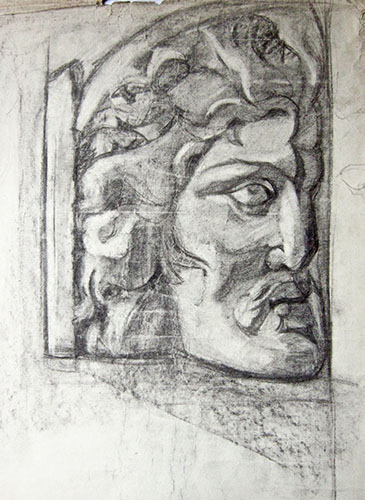
I can easily teleport myself back to those years (17-18-19 years old) and remember clearly what I felt when I was drawing then. I believed in Art, I was romantically in love with Art, it was my mission. I wasn't hesitant or doubtful but confident in my ability to take on anything Art could throw at me. The first five large drawings below were done from sculptures in the Louvre where my tutor, an école des Beaux Arts professor, would meet me every day and teach me to draw in the classical manner, with plumb line and pencil held out at arm's length to measure proportions: "Aplomb! Proportion!" he would repeat like a mantra. I can still hear it now. Each drawing took weeks and he was wonderfully severe but after a while, when he saw that I was making real progress, we became friends. He said we were now equals and that I could draw "like a man". Yes, this was before feminist consciousness-raising but my joy at this verdict was boundless.

More old drawings to come, next time.

NdA Charcoal. Roman bas-relief, Louvre. 42cm x 47cm  (16.5" x 18.5")
(The
male bits in the facing warrior were missing. Not my doing!)


NdA Charcoal. Roman portrait, Louvre. 48cm x 63cm (19" x 25")


NdA Charcoal. Roman head, Louvre. 48cm x 62cm (19" x23.5")

 
NdA Charcoal. Old Roman Senator, Louvre. 48cm x 63cm (19" x 25")


NdA  Charcoal. Roman bas-relief. 48cm x 62cm (19" x 23.5")


NdA Charcoal. 48cm x 63cm   After El Greco "The Holy Trinity" 


NdA Young self, Paris.  32.5cm x 43.5cm Charcoal and wash on oiled paper.